Student Intelligence for Schools
Know which students need attention, earlier.
COD helps schools identify meaningful changes in student learning, participation and wellbeing — helping teachers and counsellors understand where attention may be needed.
COD — Chief on Duty
COD DASHBOARD
TodayStudents need review
12
5
Academic
4
Participation
2
Social
1
Wellbeing
Student 1042
Sustained change in assessment pattern
Student 0871
Lower classroom participation over 3 weeks
Student 1196
Change in day-to-day engagement
Reviewed by authorised school staff. COD prioritises; people decide.
The problem
Schools rarely lack care. They lack visibility.
Most schools find out that a student was struggling after the fact. Not because nobody was paying attention, but because the signals were spread across a whole school day.
01
Change happens quietly
A student's learning, participation or wellbeing often shifts long before it appears in a report.
02
Attention is finite
One teacher, thirty students, six periods a day. Even attentive staff cannot watch everything.
03
Information arrives late
By the time a pattern is obvious, the moment where a small conversation would have helped has passed.
COD Student Intelligence
Detect early. Understand better. Intervene sooner.
COD is a quiet intelligence layer inside a school. The badge is the physical interface; the platform is the product.
Earlier signal
COD notices meaningful change rather than one-off moments.
Fewer, better questions
Instead of more dashboards, COD narrows the day down to the students who may need a conversation.
People stay in charge
COD never decides anything. Teachers and counsellors act with their own judgement.
How COD sits inside a school
A student wears one small badge. The school gains a clearer view.
Nothing about the school day changes. COD turns relevant signals into structured insight, and the school decides what to do with it.
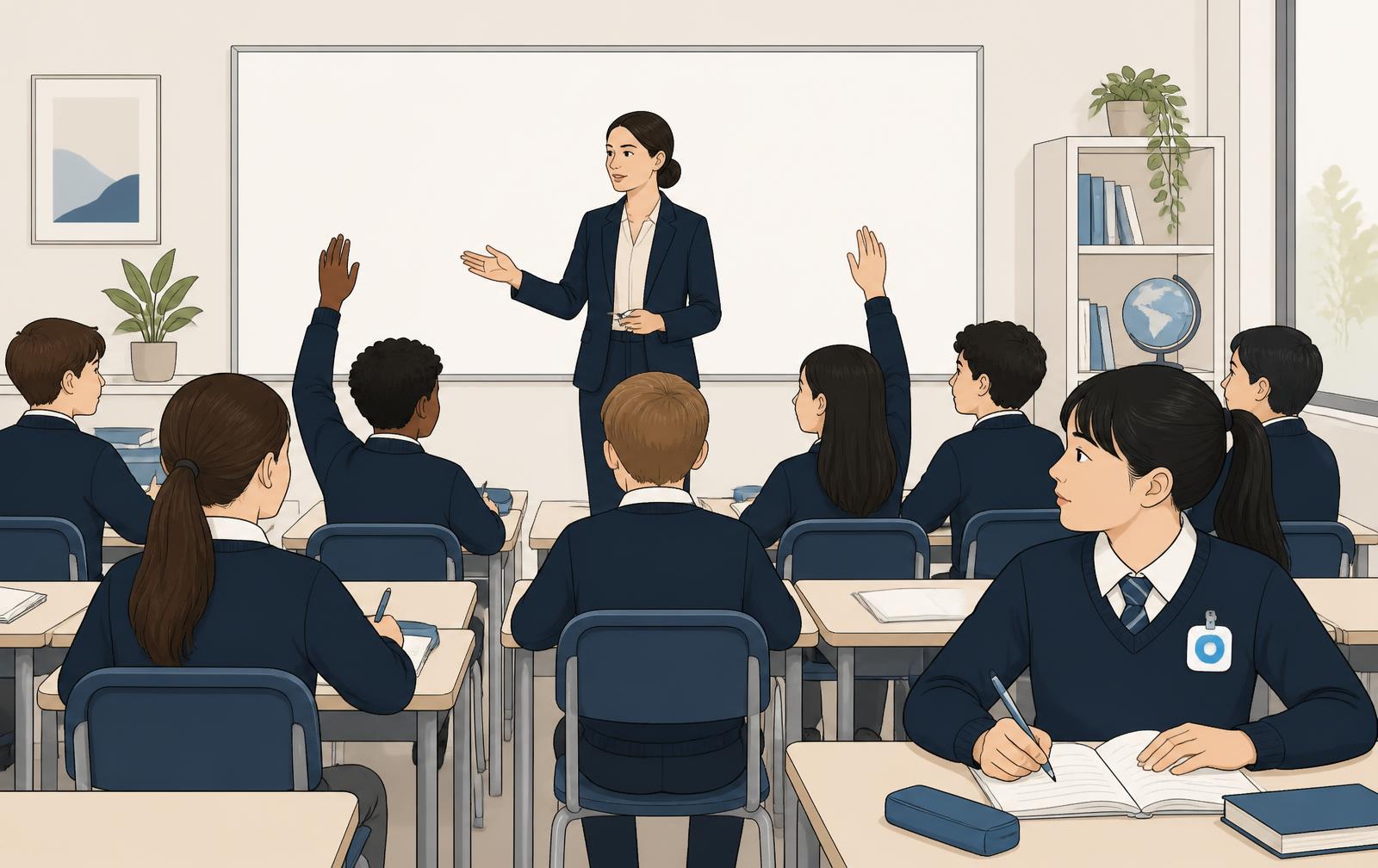
upper chest, uniform-mounted
Step 1
Student
Attends the school day as usual
Step 2
COD Badge
Small badge on the uniform
Step 3
Relevant school-day signals
Structured, not raw
Step 4
COD Intelligence
Patterns and changes over time
Step 5
School dashboard
Teacher · Counsellor · Leadership
COD does not stream live audio to teachers, show transcripts, or point cameras at students. Signals become intelligence; intelligence becomes human attention.
COD Badge
Built to stay out of the way.
The COD badge is designed to sit quietly on a student's uniform while the school day happens naturally.
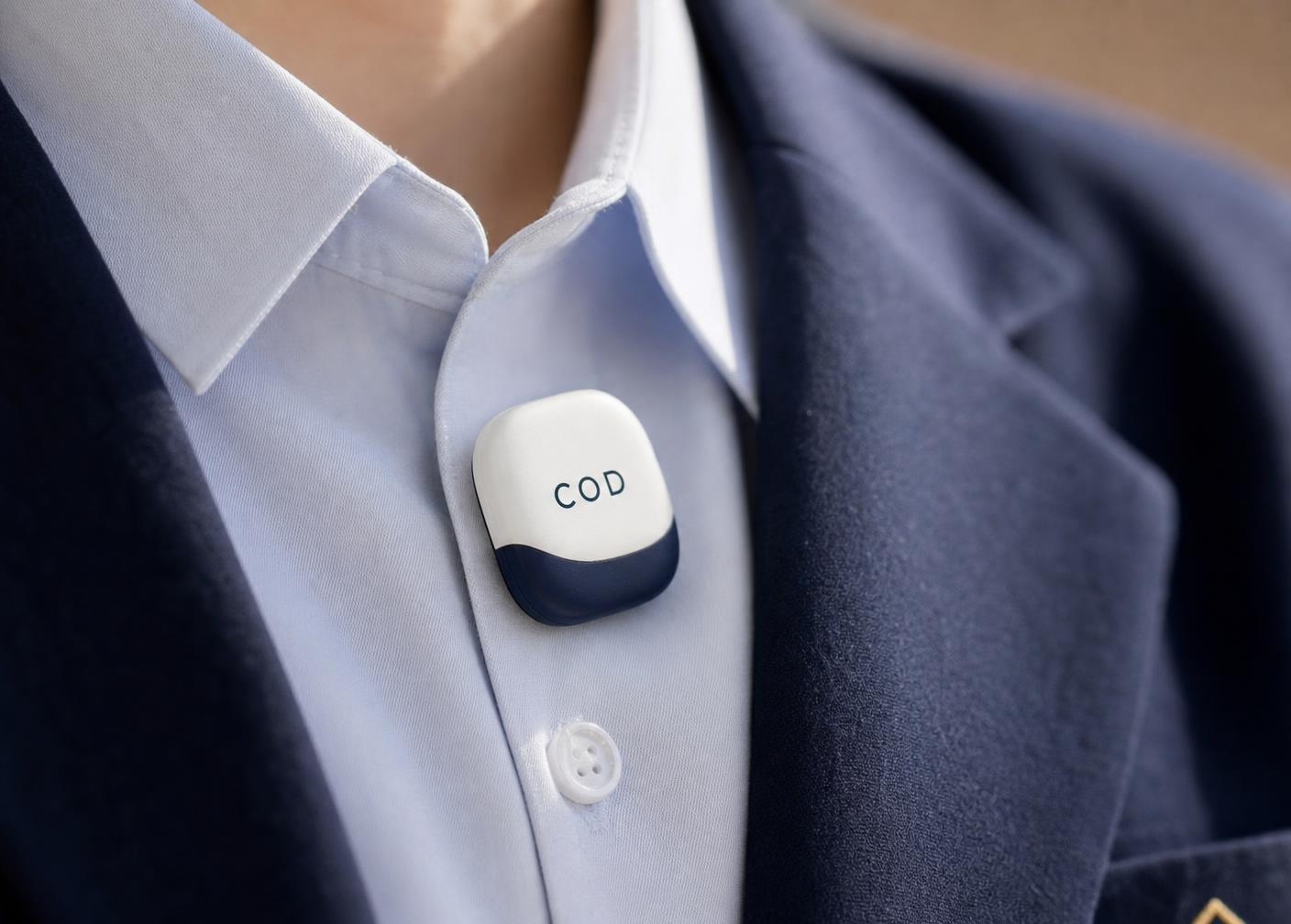
Lightweight
Designed for everyday school use.
Minimal
No distracting screen or complex controls.
Connected
Works as part of the wider COD intelligence platform.
Small, rounded, uniform-mounted. Worn on the upper chest — not around the neck, not on the wrist.
End to end
One small badge. A clearer view of every student.
Students wear a lightweight COD badge during the school day. COD converts relevant signals into structured insights that help authorised school teams understand where attention may be needed.
Step 1
Student wears COD
A lightweight badge clipped to the uniform, around the upper chest.
Step 2
School day happens naturally
Teaching, participating, group work, learning. Nothing is staged.
Step 3
COD understands patterns
Relevant signals are structured into patterns and changes over time.
Step 4
School receives insight
A short, prioritised view: who may need attention today, and in which area.
Step 5
Human intervention
A teacher or counsellor has an ordinary conversation with the student.

Technology detects the signal. People make the difference.
COD Platform
Observe. Understand. Detect change. Prioritise. Intervene.
COD is built around intelligence and outcomes, not recording and retrieval.
- COD Badge→
- Understand→
- Detect Change→
- Prioritise→
- Human Intervention
Understand
Relevant school-day signals are structured into meaningful context.
Detect change
COD looks for shifts against a student's own pattern over time.
Prioritise
Only a small number of students surface for review on a given day.
Human intervention
A teacher or counsellor follows up in an ordinary way.
COD Dashboard
A short list, not a data dump.
Authorised school staff open COD and see where attention may be needed today, grouped by area.
COD DASHBOARD
TodayStudents need review
12
5
Academic
4
Participation
2
Social
1
Wellbeing
Student 1042
Sustained change in assessment pattern
Student 0871
Lower classroom participation over 3 weeks
Student 1196
Change in day-to-day engagement
Reviewed by authorised school staff. COD prioritises; people decide.
Grouped by area
Academic, Participation, Social and Wellbeing keep the view readable at a glance.
Change, not scores
COD highlights movement against a student's own pattern rather than ranking students.
Access controlled
Only authorised staff see student-level detail, scoped to their role.
Student profile
Enough context for a good conversation.
A student view in COD is built to prepare a teacher or counsellor, not to profile a child.
Student 0871
Year group view · Participation
Participation
Lower than usual
Learning
Steady
Interaction
Narrower group
Change over time
Third week
Suggested next step
An informal check-in by the form tutor. COD suggests; the school decides.
Not included
No transcripts, no live audio, no playback controls.
For the whole school team
One layer, three different jobs.
Teachers
See where attention may be needed in their own classes, without extra admin.
Counsellors
Understand context before a conversation, and follow change over time.
Leadership
See patterns across year groups and where support is concentrated.
COD School Intelligence
Zoom out from a student to a school.
The same signals that help one teacher help a school understand where support is needed across year groups and terms.
Year group view
Where participation or engagement is shifting as a group.
Term over term
Whether earlier intervention changed the trajectory.
Support planning
Where limited counselling and pastoral time is best spent.
Privacy
The school stays in control.
COD is designed to be explainable to a parent, a teacher and a school board in the same conversation.
Insight, not surveillance
COD is built around structured signals and patterns — not live listening, transcripts or playback.
Role-based access
Student-level detail is visible only to authorised staff, scoped to their role in the school.
School ownership
The school defines who is enrolled, who has access, and how insights are used.
Human decisions
COD prioritises where attention may be needed. Every decision stays with people.
COD Pilot
Start with one year group.
A COD Pilot is designed to be small, observable and easy for a school to evaluate on its own terms.
Step 1
Scope it small
Choose a single year group or a defined set of classes.
Step 2
Run it quietly
Students wear the COD badge through a normal school day.
Step 3
Review together
Look at what COD surfaced and whether it was useful.
School perspective
From hundreds of students to the few who may need attention.
COD is not designed to give schools more information. It is designed to narrow the day down.
Classroom
1 Teacher
↓
30 Students
Whole school
Principal
↓
500–2,000
students across the school
COD
↓
Who needs attention today?
Today's shortlist
Long-term vision
A quiet intelligence layer for education.
Over time, COD aims to make early understanding an ordinary part of school life — so that support arrives while it still makes a difference. The badge is the physical interface; the intelligence platform is the real product.